Are Mortgage Brokers Worth It in Florida?
Buying a home is already a big financial decision, so adding another person to the mortgage process can make you wonder whether it is actually worth it. The answer is not always yes or no. For some Florida homebuyers, a mortgage broker can make the process easier and help them compare more loan options. For others, going directly to a bank or lender may be perfectly reasonable. The real question is whether the broker brings enough value to justify the cost.
What Does a Mortgage Broker Actually Do?
A mortgage broker does not usually lend you the money directly. Instead, a broker works with lenders and helps borrowers find mortgage options that may fit their financial situation.
The Consumer Financial Protection Bureau explains that mortgage brokers typically work with multiple lenders, while a direct lender makes the loan itself. Brokers can receive a loan-specific fee or commission, which may be paid by the borrower or lender depending on the arrangement.
That access to multiple lenders is one of the main reasons borrowers consider using a broker.
Why a Florida Buyer Might Choose a Broker
Imagine you are self-employed, buying a higher-priced home, purchasing an investment property, or dealing with a financial situation that does not fit neatly into a standard mortgage application.
Walking into one bank may give you access to that bank’s products. A broker may be able to look across multiple lenders and find programs that better match your circumstances.
This does not guarantee a better rate or approval. It simply gives you another way to shop for financing.
Brokers Can Save Time
Mortgage shopping can become surprisingly time-consuming.
You may have to compare interest rates, loan programs, closing costs, credit requirements, documentation, and lender fees. A broker can handle some of that comparison work for you.
For someone who does not want to contact several lenders individually, that convenience can have real value.
Still, it is worth asking what the broker is actually doing for you. If you are already comfortable comparing lenders yourself, you may decide that paying for that convenience is not necessary.
They May Be Helpful With Complicated Loans
Not every borrower has a simple W-2 income and a straightforward home purchase.
Florida buyers may be looking at jumbo loans, investment properties, condos, second homes, self-employed income, or other situations that require more careful lender selection.
A broker who regularly handles the type of loan you need may know which lenders are more comfortable with that particular scenario.
That experience can be useful when a standard lender says no, but another lender may have a suitable program.
What About the Cost?
This is where the decision becomes more personal.
Mortgage brokers can be compensated in different ways. The CFPB says broker or loan officer compensation can be paid by the borrower or lender, and borrowers should understand the fees and who is paying them before working with a broker.
You should therefore avoid looking only at whether a broker advertises “no broker fee.” A cost can sometimes be reflected elsewhere in the loan pricing.
Look at the complete offer, including the interest rate, APR, points, lender charges, broker compensation, closing costs, and cash required to close.
Compare the Broker With a Direct Lender
One of the easiest ways to decide whether a broker is worth it is to compare the actual numbers.
You might receive an offer from a mortgage broker and another directly from a bank or lender. Put the offers side by side.
For example, look at:
- Interest rate
- APR
- Loan term
- Points
- Origination charges
- Broker compensation
- Closing costs
- Monthly payment
- Cash needed at closing
The CFPB recommends shopping around for mortgage loans and comparing the overall terms and costs rather than choosing based on one number.
Sometimes the broker may find a better overall deal. Sometimes the direct lender may win. The numbers should make that clear.
A Lower Rate Is Not Everything
This is an easy mistake to make when comparing mortgages.
Suppose one loan has a slightly lower interest rate but requires substantial points and higher upfront costs. Another has a slightly higher rate but much lower costs at closing.
Which one is better?
It depends on how long you expect to keep the mortgage and what you can comfortably afford upfront.
That is why comparing the complete loan cost is more useful than simply asking, “Who has the lowest rate?”
Florida-Specific Experience Can Help
Florida has a wide range of housing and borrowing situations. A buyer in Miami may be looking at a luxury condo, while someone in Orlando may be buying a primary residence and another buyer near Tampa may be considering an investment property.
The location itself does not automatically determine whether a broker is better. What matters is whether the broker understands the type of property and loan you are dealing with.
Florida also regulates mortgage brokers and loan originators. The Florida Office of Financial Regulation states that mortgage broker entities conducting covered loan-originator activities must be licensed, while individual loan originators are subject to licensing requirements as well.
When a Mortgage Broker May Be Worth It
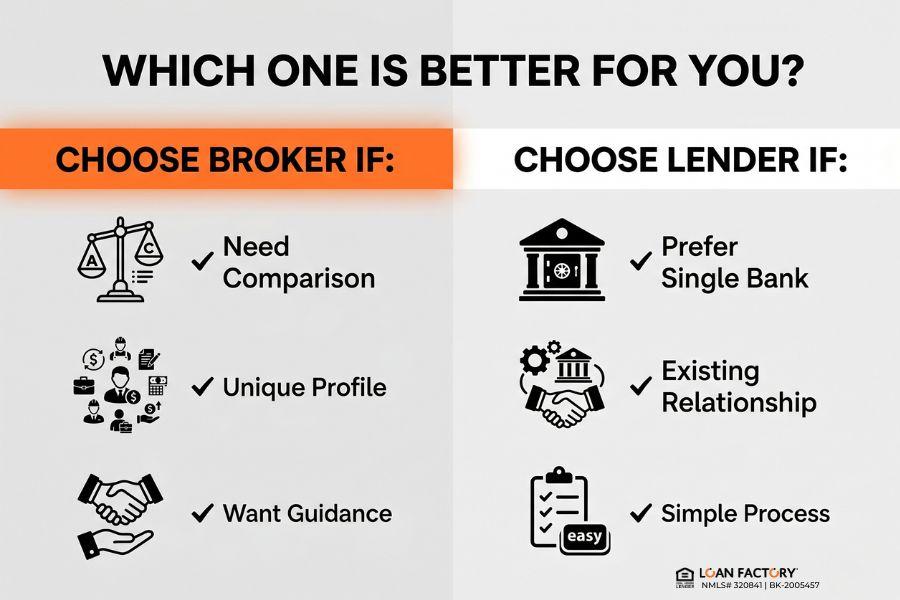
A broker may be worth considering if:
- You want to compare multiple lenders.
- Your financial situation is more complicated.
- You are self-employed.
- You need a jumbo mortgage.
- You are purchasing an investment or second home.
- You do not have time to contact multiple lenders yourself.
- You want someone to help explain different loan programs.
- The broker can provide a competitive overall loan offer.
The key is that the broker should bring something useful to the table.
When You May Not Need One
You may not need a mortgage broker if you already have a lender offering competitive terms and you are comfortable handling the comparison yourself.
For example, if your bank offers the mortgage program you need at a competitive rate and reasonable fees, adding another person to the process may not provide much additional value.
There is also nothing wrong with talking to both. Getting information from a broker does not mean you have to use that broker.
Questions to Ask Before Choosing a Broker
Before agreeing to work with one, ask:
- How are you compensated?
- Who pays your compensation?
- How many lenders do you work with?
- Do you handle my type of loan regularly?
- What fees will I pay?
- Can you provide a Loan Estimate?
- Are there lender credits or points involved?
- What will my estimated cash-to-close be?
- How will you communicate with me during the process?
A straightforward answer to these questions is a good starting point.
FAQs
1. Is it cheaper to use a mortgage broker in Florida?
Not necessarily. A broker may help you find a competitive loan, but the broker’s compensation and other loan costs need to be considered. Compare the complete mortgage offer rather than assuming a broker will automatically be cheaper.
2. Can a mortgage broker get me a lower interest rate?
A broker may have access to different lenders and loan products, which can give you more options. However, there is no guarantee that a broker will offer a lower rate than a bank or direct lender.
3. Are mortgage brokers licensed in Florida?
Florida has licensing requirements for mortgage broker entities and loan originators. The Florida Office of Financial Regulation provides information about these requirements and uses the Nationwide Mortgage Licensing System for mortgage licensing processes.
4. How do I know if a mortgage broker is worth the cost?
Compare the broker’s offer with offers from direct lenders. Look at the rate, APR, points, broker compensation, lender fees, closing costs, and cash required to close. If the broker provides better overall terms or saves you significant time with a complicated loan, the cost may be worthwhile.
Final Thoughts
So, are mortgage brokers worth it in Florida? For many borrowers, they can be, especially when the mortgage is complicated or you want help comparing multiple lenders. But using a broker should never mean automatically accepting whatever loan they present.
Take a little time to compare the complete numbers. Ask how the broker is paid, review your Loan Estimate, and compare the offer with at least one direct lender. If the broker can provide competitive terms and make the process easier, that added value may be worth it.