Best Mortgage Options for Self-Employed Borrowers in Florida
Being self-employed can give you freedom over your work and income, but buying a home can sometimes feel like a different story. Instead of simply handing over a few recent pay stubs, you may need to explain business income, tax deductions, bank deposits, and how your business has been performing. That is why finding the best mortgage options for self-employed borrowers in Florida often starts with understanding how lenders look at your income.
A business owner earning good money may still have trouble qualifying if their taxable income looks much lower after deductions. On the other hand, a well-organized borrower with consistent business income and solid documentation may have several mortgage choices.
Conventional Mortgages for Self-Employed Borrowers
A conventional mortgage can be a strong option if your business has a stable financial history and your income is easy to document.
For conventional underwriting, lenders generally look at whether your self-employment income is stable and likely to continue. Fannie Mae considers factors such as the stability of the business, its financial strength, the nature of the business, and whether it can continue generating enough income for the borrower. A two-year history is generally expected, although some borrowers with less than two years of self-employment may qualify when they have qualifying prior experience and other supporting documentation.
This option can make sense for established Florida business owners who have strong credit, sufficient assets, and tax returns that clearly support their ability to make the mortgage payment.
FHA Loans May Help Some Borrowers
FHA loans are another possibility, particularly for borrowers who may not have a large down payment or who have less-than-perfect credit.
The Federal Housing Administration does not lend money directly. Instead, FHA loans are offered through approved private lenders and insured by the government. FHA loans can allow down payments as low as 3.5%, although mortgage insurance is required.
For a self-employed borrower, however, the important question is not simply whether an FHA loan accepts self-employed applicants. The lender still needs documentation that supports the income being used to qualify. Your specific financial situation, credit profile, business history, and lender requirements all matter.
Bank Statement Loans
For some self-employed borrowers, a bank statement mortgage may be worth discussing.
Instead of relying entirely on traditional tax-return income calculations, certain non-QM lenders offer programs that use personal or business bank deposits to help demonstrate cash flow. These programs can be particularly interesting for business owners whose tax returns show lower income because of legitimate business deductions.
But there is an important tradeoff. A bank statement program is not automatically better simply because it uses bank deposits. Interest rates, down payment requirements, reserves, fees, and underwriting standards can differ substantially from conventional financing.
The Consumer Financial Protection Bureau recommends comparing loan offers based on the overall cost and terms rather than focusing on one feature or advertised rate.
Jumbo Mortgages for Higher-Priced Florida Homes
Florida has plenty of higher-priced housing markets, and some buyers may need financing above conventional loan limits. A jumbo mortgage could be an option when the amount you need to borrow is too large for a conforming loan.
Self-employed borrowers seeking jumbo financing should expect detailed financial review. Lenders may look closely at business performance, personal and business assets, reserves, credit history, and income documentation.
If you are purchasing an expensive property, it is worth comparing a jumbo option with a combination of other financing strategies rather than assuming one loan type is automatically the best choice.
What Documents Should Self-Employed Borrowers Prepare?
Documentation can make a major difference in how smoothly the mortgage process goes.
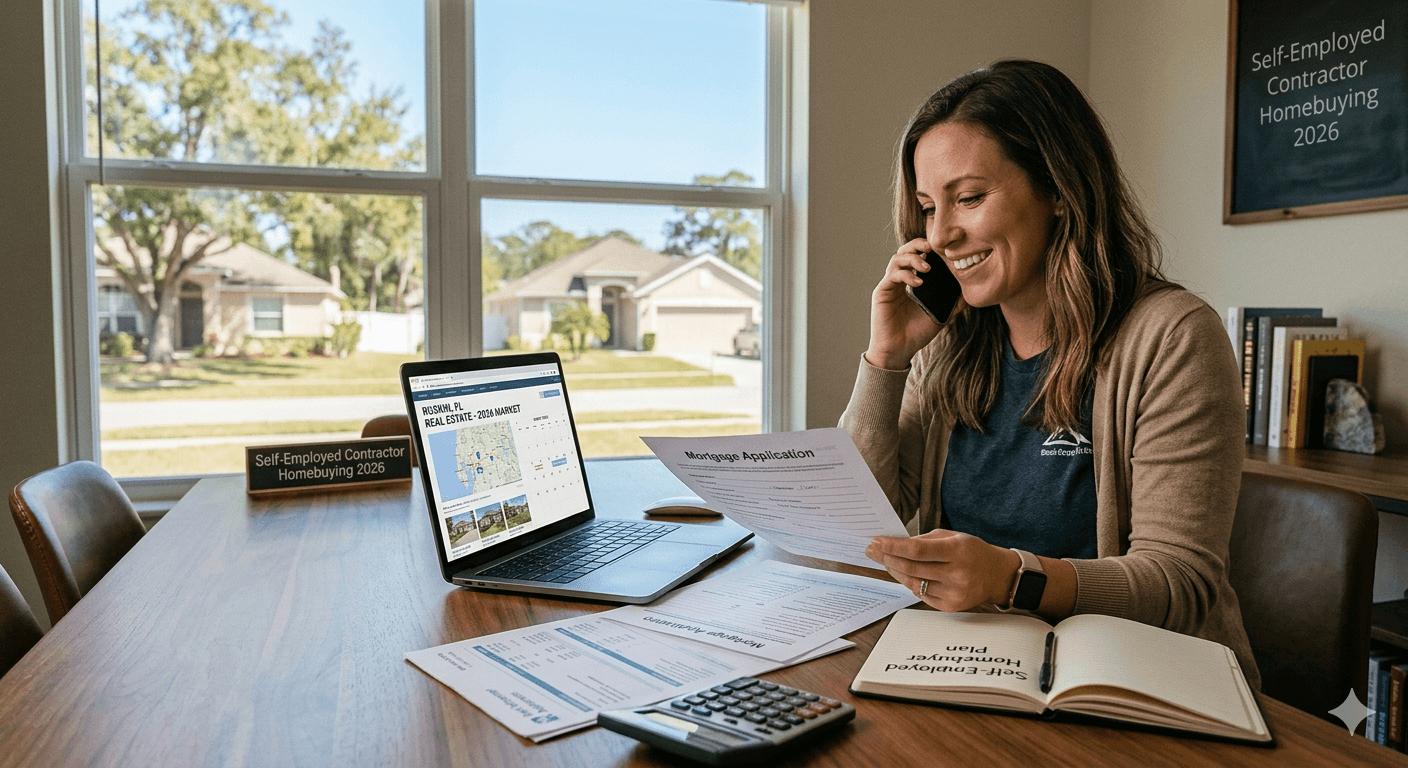
Depending on the loan and lender, you may need personal and business tax returns, profit-and-loss statements, bank statements, 1099 forms, business information, and documentation showing your assets. Fannie Mae’s general mortgage-document checklist specifically includes tax returns, profit-and-loss statements or business tax returns, bank and investment account statements, and business licenses where applicable.
It is also important to keep personal and business finances organized. Large unexplained deposits, inconsistent records, or sudden financial changes can lead to additional questions during underwriting.
What If You Take Large Business Tax Deductions?
This is where some self-employed borrowers get surprised.
A business owner might have substantial revenue but report significantly less taxable income after expenses and deductions. While those deductions may be perfectly legitimate for tax purposes, mortgage underwriting focuses on income that can be relied upon for repayment.
That does not necessarily mean you cannot qualify. It simply means your lender needs to determine what portion of the business income can reasonably be used for mortgage qualification.
Compare More Than One Mortgage Option
There is no single mortgage that is best for every self-employed Florida borrower.
A conventional loan may offer attractive terms for someone with strong documented income. FHA financing may be worth exploring for another borrower. A bank statement program could make more sense for someone whose tax returns do not accurately reflect the cash flow available to them. A jumbo mortgage may be necessary for a higher loan amount.
The smartest approach is to have lenders compare several scenarios using your actual income, credit, assets, business history, and target purchase price. CFPB guidance also recommends comparing different loan choices and getting multiple quotes when more than one option may fit.
4 FAQs About Mortgages for Self-Employed Borrowers in Florida
1. Can self-employed people qualify for a mortgage in Florida?
Yes. Self-employed borrowers can qualify for conventional, FHA, jumbo, and other mortgage programs when they meet the applicable lender requirements and can document qualifying income and financial stability.
2. Do self-employed borrowers need two years of tax returns?
Not necessarily in every situation. Requirements vary by loan program and lender. Conventional underwriting generally looks for a two-year history, although exceptions can apply when a borrower has less than two years of self-employment and can document qualifying prior experience.
3. What is a bank statement mortgage?
A bank statement mortgage is generally a non-QM loan program that may use deposits shown in bank statements to evaluate a self-employed borrower’s cash flow rather than relying solely on traditional tax-return income calculations. Availability and requirements vary by lender.
4. What documents should I prepare before applying?
Be prepared to provide items such as tax returns, bank statements, business financial records, profit-and-loss statements, 1099s, asset documentation, and information about your business. Your lender will tell you exactly which documents apply to your loan.
Final Thoughts
Being self-employed should not automatically put homeownership out of reach. The key is understanding how a lender will view your income before you start shopping seriously for a property.
If your tax returns, bank statements, business records, and personal finances are organized, you may have more choices than you initially expect. Take time to compare conventional, FHA, bank statement, jumbo, and other available programs based on the complete cost—not just the advertised interest rate. A mortgage professional who regularly works with self-employed borrowers can help you determine which options actually fit your financial picture.