Can Closing Costs Be Rolled Into a Refinance in Florida?
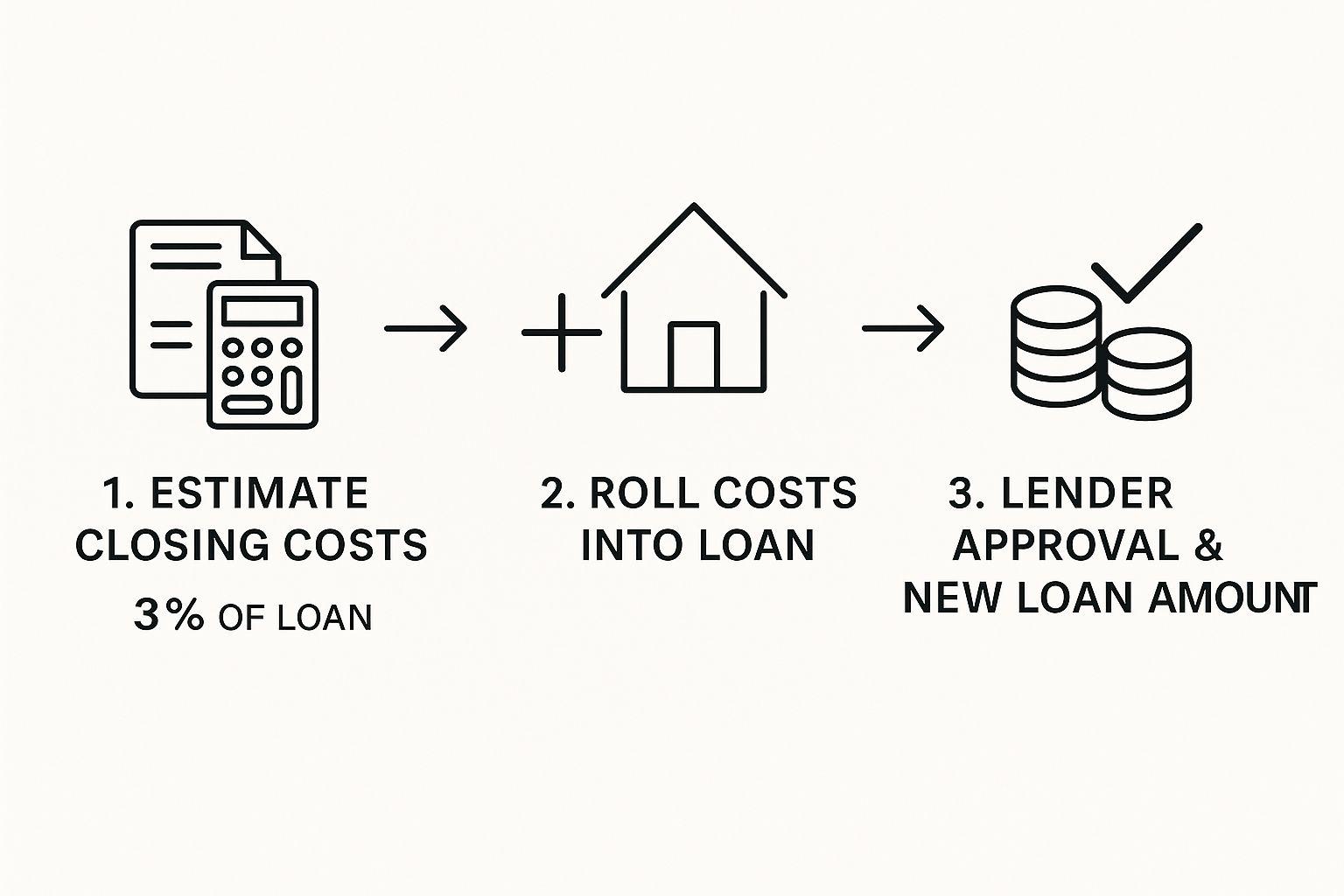
Yes, closing costs can sometimes be rolled into a refinance in Florida, depending on your lender, loan program, equity, and the specific terms of the new mortgage. Instead of paying all the refinancing expenses out of pocket, you may be able to add eligible costs to your new loan balance.
That can make refinancing easier when you don’t want to bring several thousand dollars to the closing table. But there is an important tradeoff: you are borrowing more money, which means you may pay additional interest over the life of the mortgage.
What Does “Rolling Closing Costs Into a Refinance” Mean?
Let’s say you currently owe $300,000 on your Florida home.
Your new refinance has approximately $8,000 in eligible closing costs.
Instead of paying that $8,000 upfront, your lender may allow you to include it in the new mortgage.
The simplified numbers could look like:
Existing mortgage: $300,000
Closing costs financed: $8,000
New mortgage: $308,000
You wouldn’t necessarily need to bring the entire $8,000 to closing, but your new mortgage balance would be higher.
That means you’ll generally pay interest on the additional amount as well.
Is It the Same as a No-Closing-Cost Refinance?
Not exactly.
A no-closing-cost refinance generally means you’re using another method to avoid paying the costs upfront. A lender may provide credits toward closing costs in exchange for a higher interest rate, or certain costs may be incorporated into the new loan.
So when a lender says, “You don’t have to pay closing costs upfront,” ask exactly how those costs are being handled.
You may be:
- Adding them to the loan balance
- Receiving a lender credit
- Accepting a higher interest rate
- Paying some costs upfront and financing others
Each option affects the overall cost differently.
What Closing Costs Can Be Rolled Into the Loan?
The costs that can be financed depend on the lender and loan program.
Potential expenses can include:
- Origination charges
- Appraisal fees
- Title services
- Recording charges
- Certain prepaid expenses
- Other eligible closing costs
Not every expense can necessarily be added to every refinance, so your lender should provide a detailed breakdown.
Your Loan Estimate is particularly useful here because it shows the estimated costs and loan terms before closing.
Florida Has Additional Mortgage-Related Costs
Florida homeowners should pay attention to state-specific taxes when refinancing.
The Florida Department of Revenue explains that recorded mortgages and other evidence of indebtedness are subject to documentary stamp tax. The rate is $0.35 per $100 of the amount secured, with no cap on the tax.
For example, if a new mortgage secured $300,000:
$300,000 × 0.35% = $1,050
That’s just an illustration of the documentary stamp tax calculation; your actual transaction should be reviewed by your lender or closing professional.
Florida also has other mortgage-related tax rules, so don’t assume your refinance costs will be identical to those in another state.
Does Rolling Costs Into the Mortgage Save Money?
It can save you cash upfront, but it doesn’t necessarily save you money overall.
Imagine you have $7,000 in refinance costs.
Option 1: Pay upfront
You pay the $7,000 at closing and keep the new mortgage balance lower.
Option 2: Add it to the mortgage
You keep more cash available but increase the amount you owe.
If you finance the $7,000, you’ll potentially pay interest on that amount for years.
That’s why the better question isn’t simply:
“Can I avoid paying closing costs today?”
It’s:
“What will these closing costs ultimately cost me if I finance them?”
What About Lender Credits?
Another possibility is a lender credit.
For example, a lender might offer a credit toward your closing expenses if you accept a slightly higher interest rate.
This can be useful if preserving cash is more important to you than getting the absolute lowest possible rate.
But compare both options carefully.
A $5,000 credit may sound great, but if the higher interest rate costs you substantially more over several years, the credit may not be the best financial choice.
Can You Roll Closing Costs Into a Cash-Out Refinance?
A cash-out refinance replaces your existing mortgage with a larger loan and gives you access to some of your home equity, subject to applicable lender and loan-program requirements.
Because the new loan is larger, there may be room to incorporate eligible closing expenses into the transaction.
For example:
Home value: $500,000
Existing mortgage: $250,000
New refinance: $275,000
The difference isn’t automatically all cash in your pocket. Closing costs and other amounts can reduce the cash you actually receive.
So don’t calculate your available cash simply by subtracting the old mortgage from the new one.
How Much Equity Do You Need?
Your available equity can matter when you’re trying to finance closing costs.
A lender will look at factors such as:
- Property value
- Existing mortgage balance
- New loan amount
- Loan-to-value ratio
- Credit profile
- Income
- Debt-to-income ratio
- Loan program
Adding closing costs to your mortgage increases the new loan amount, which can affect your loan-to-value ratio.
That’s why the lender needs to review your complete financial situation before confirming whether the costs can be financed.
Does Rolling Costs Increase Your Monthly Payment?
It can.
Suppose your new mortgage would have been $300,000, but you add $8,000 in closing costs.
Now you’re potentially borrowing $308,000 instead.
The difference in monthly payment may not seem huge, but you’re also paying interest on the additional $8,000.
Over a long mortgage term, those extra interest charges can add up.
Calculate the Break-Even Point
Before refinancing, compare the cost of the refinance with the monthly savings.
For example:
Refinance costs: $8,000
Monthly savings: $300
$8,000 ÷ $300 = approximately 27 months
Your basic break-even point would be about 27 months.
However, if you finance the $8,000 rather than paying it upfront, you should also account for the interest you’ll pay on that additional balance.
When Rolling Closing Costs May Make Sense
Financing the costs could make sense if:
- You don’t want to use your emergency savings.
- You need to keep cash available for home repairs.
- Your new mortgage still provides meaningful monthly savings.
- You expect to stay in the home for several years.
- The additional loan balance doesn’t significantly affect your loan terms.
It may be less attractive if you’re only planning to keep the mortgage for a short period or the additional borrowing substantially reduces your savings.
Ask Your Lender for Both Options
A good way to compare is to ask the lender for two scenarios:
Option A: Pay closing costs upfront with the lowest available rate.
Option B: Finance eligible costs or receive a lender credit.
Then compare the:
- Interest rate
- Monthly payment
- Loan balance
- Cash needed at closing
- Total interest
- APR
- Break-even period
This gives you a much clearer picture than simply asking which option has the lowest closing costs.
Frequently Asked Questions
Can I roll closing costs into a refinance in Florida?
Yes, in some circumstances. Eligible closing costs may be financed into the new mortgage, subject to the lender’s requirements and applicable loan-program rules.
Does rolling closing costs into my mortgage mean they’re free?
No. You’re generally borrowing the money rather than eliminating the expense. The higher loan balance can result in additional interest over time.
Is it better to pay refinance costs upfront?
Not necessarily. It depends on your available cash, new interest rate, monthly savings, and how long you expect to keep the mortgage.
Can lender credits cover refinance closing costs?
Potentially. A lender may provide credits toward closing costs, but these can come with different loan pricing or a higher interest rate.
Final Thoughts
So, can closing costs be rolled into a refinance in Florida? In many cases, yes—but it depends on your loan and lender.
Financing the costs can reduce the amount of cash you need at closing, which can be helpful if you want to keep your savings intact. But remember that you’re not making the costs disappear. You’re shifting them into the mortgage and potentially paying interest on them.
Before choosing a refinance, ask your lender to show you the numbers with and without the closing costs financed. Comparing those two options can make it much easier to see which choice actually works better for your Florida home.