How Much Down Payment Do You Need to Buy a House in Florida?
Saving for a home can make the down payment feel like the biggest hurdle before you even start looking at houses. But you may not need 20% sitting in your bank account to buy a home in Florida. The amount you need depends on the mortgage program you qualify for, the property you are buying, your credit profile, and whether you qualify for assistance. So, if you are wondering how much down payment you need to buy a house in Florida, the answer is not one fixed number.
For some buyers, putting down a smaller amount can make homeownership possible sooner. For others, making a larger down payment may reduce the monthly mortgage payment and borrowing costs. The important part is understanding what you can comfortably afford rather than simply trying to hit a particular percentage.
You May Not Need 20% Down
The 20% figure gets mentioned so often that many buyers assume it is a requirement. It is not.
Mortgage programs can have different down payment requirements, and the right option depends on your financial situation. Conventional financing may allow a relatively small down payment for qualified borrowers, while FHA financing can also provide a lower-down-payment path. VA and USDA loans may offer eligible borrowers financing with little or no down payment, subject to their program requirements.
That means someone shopping for a $350,000 home does not automatically need $70,000 just to make an offer possible.
Still, a smaller down payment does not necessarily mean buying a home is inexpensive. You also need to consider closing costs, prepaid expenses, inspections, insurance, taxes and the money you want to keep available after closing.
Your Home Price Changes the Number
The dollar amount behind a percentage can be surprisingly different.
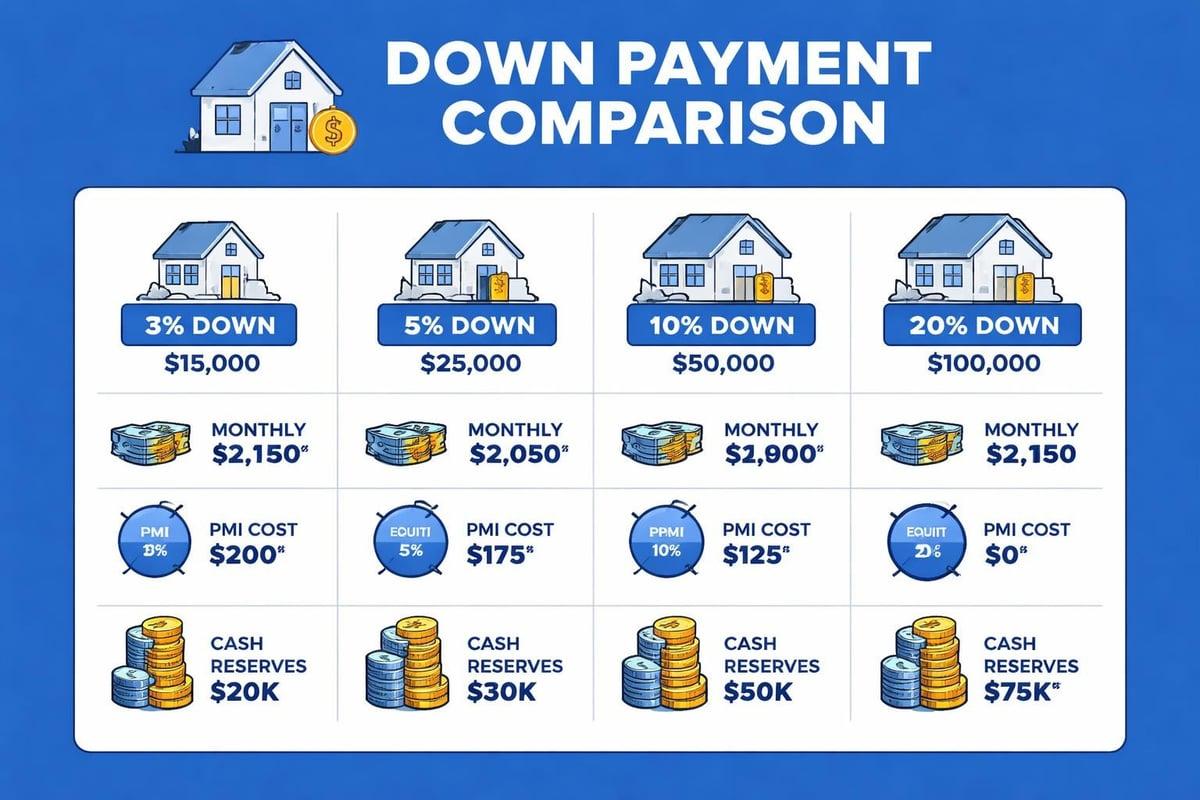
For example, a 5% down payment on a $300,000 home is $15,000. On a $500,000 home, that same 5% becomes $25,000.
That is why it is better to work backward from a realistic home price instead of choosing a down-payment percentage first. Look at your income, monthly debts, savings and expected housing costs, then determine what purchase price makes sense.
Florida buyers should also remember that property-related costs can vary significantly from one area to another. Insurance, taxes, HOA fees and other expenses can change the monthly cost of owning the same-priced home.
Florida Has Down Payment Assistance Options
One of the more interesting things for Florida buyers is that some eligible homebuyers may be able to receive assistance rather than coming up with the entire down payment themselves.
Florida Housing Finance Corporation offers programs that can help eligible buyers with down payment and closing costs. Its current Homebuyer Program includes 30-year fixed-rate first mortgages through participating lenders, with eligibility requirements that can include credit score, income, purchase-price limits and first-time-homebuyer status.
For example, Florida Housing’s FL Assist program can provide up to $10,000 for eligible borrowers using FHA, VA, USDA or conventional loans. It is structured as a deferred second mortgage rather than a simple cash grant, so buyers need to understand when repayment becomes due.
There are also other Florida Housing assistance programs, including second-mortgage options that may provide 3%, 4% or 5% of the first mortgage amount for qualifying borrowers. Some of these programs have forgiveness provisions, while others must eventually be repaid.
So before assuming you need to save every dollar yourself, it is worth checking what programs you may qualify for.
First-Time Buyers Should Look at More Than the Down Payment
Being a first-time buyer can open the door to programs that are worth investigating.
Florida Housing generally uses the IRS definition of a first-time homebuyer for its Homebuyer Program, which generally means you have not owned and occupied a primary residence during the previous three years. The program also has credit, income, purchase-price and education requirements.
Local governments may also have housing assistance through SHIP, or the State Housing Initiatives Partnership program. Florida Housing maintains information about local housing assistance plans throughout the state.
This is particularly useful for buyers who have steady income but simply have not been able to accumulate a large amount of cash for the upfront costs of buying.
Do Not Empty Your Savings for the Down Payment
This is where some buyers get caught off guard.
Imagine you have $30,000 saved and find a house you really like. You could potentially put most of that money toward the down payment, but then what happens when the air conditioner needs attention, an appliance breaks, or another unexpected expense comes up?
Homeownership comes with costs that renters do not always have to handle directly.
Keeping an emergency fund after closing can be just as important as getting the keys. A slightly smaller down payment may sometimes leave you with more financial breathing room, while a larger down payment may make sense if you can comfortably afford it and want to reduce the amount you borrow.
There is no universal answer.
Your Down Payment Is Only One Part of the Purchase
When planning your home-buying budget, think beyond the down payment.
You may need money for:
- Closing costs
- Home inspection
- Appraisal
- Prepaid property taxes and insurance
- Homeowners insurance
- HOA or condominium expenses
- Moving costs
- Immediate repairs or improvements
- Emergency savings
This is especially important in Florida, where homeowners should pay close attention to insurance costs and the property’s condition before committing to a purchase.
A house that looks affordable based on the mortgage payment alone can feel very different once all of the ownership expenses are added together.
What Should You Aim to Save?
Instead of asking only, “How much down payment do I need?” consider asking, “How much cash do I want available when I become a homeowner?”
That amount could include your planned down payment, estimated closing costs and an emergency reserve.
A lender can help you understand how different down-payment amounts affect the mortgage, while a real estate professional can help you understand property-specific costs. If you are considering an assistance program, check its current eligibility rules before counting on those funds.
Florida Housing’s programs, for example, have specific requirements and must generally be used through participating lenders rather than treated as unrestricted cash assistance.
Final Thoughts
There is no single down-payment number that works for every Florida homebuyer. A buyer may qualify with a relatively small down payment, while another may choose to put down more because it fits their financial goals.
The smarter approach is to look at the complete picture: purchase price, mortgage payment, insurance, taxes, closing costs, savings and the cash you will still have after closing.
For many buyers, the goal is not simply to put the most money down. It is to buy a home without putting their entire financial cushion at risk.