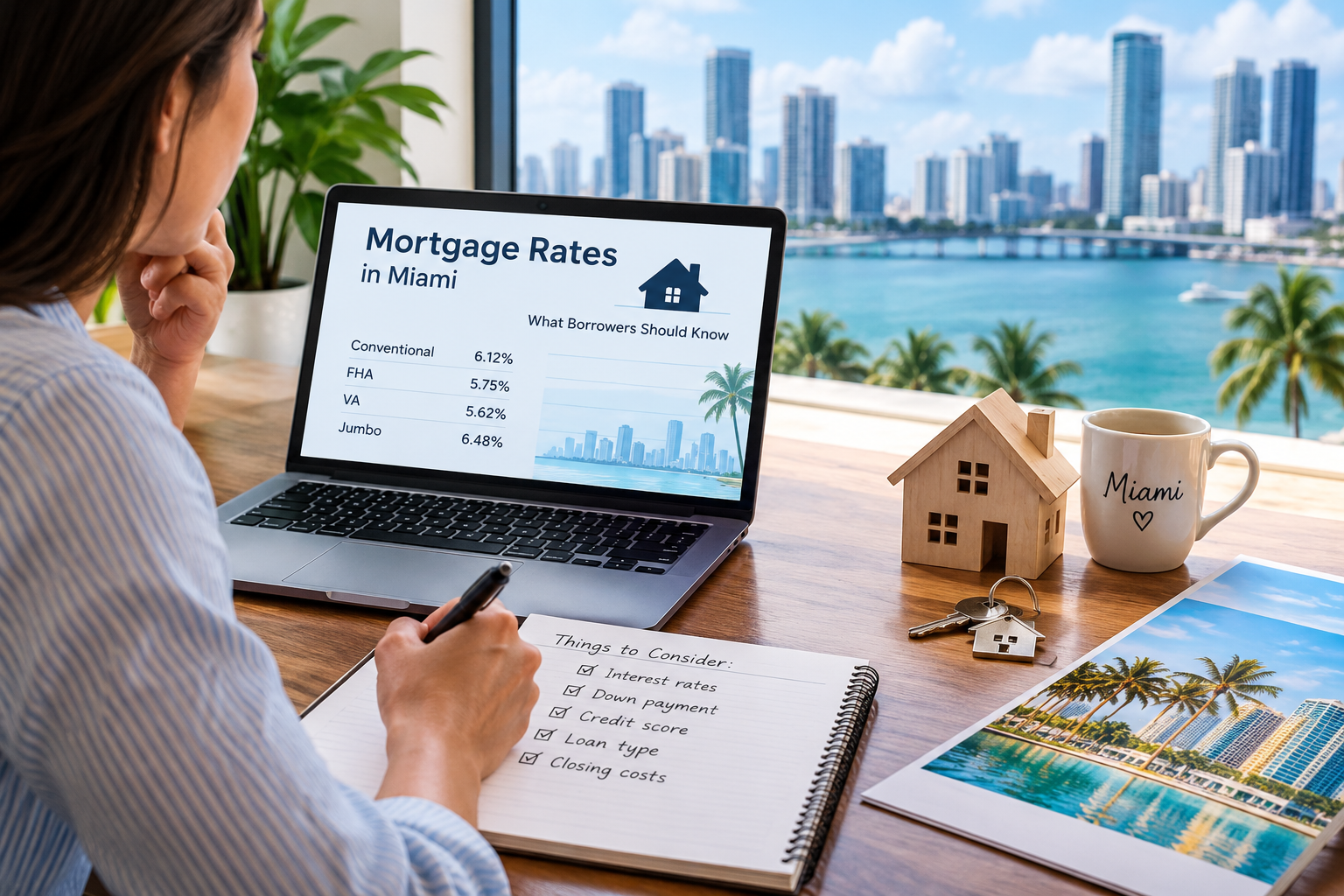
Mortgage Rates in Miami: What Borrowers Should Know
Buying a home in Miami can make the mortgage rate feel just as important as the price of the property. Even a small difference in the interest rate can change the monthly payment and the amount of interest paid over the life of the loan. If you are looking at mortgage rates in Miami, it helps to understand that the rate advertised online is not necessarily the rate you will personally receive. Your credit, down payment, loan type, property, loan amount, and other factors can all affect your offer.
As of September 10, 2026, Freddie Mac’s national weekly survey showed the average 30-year fixed mortgage rate at 6.76% and the 15-year fixed rate at 6.09%. These are national averages, not Miami-specific quotes, and individual borrowers can receive different rates.
Miami Mortgage Rates Can Vary From One Borrower to Another
Two people can walk into different lenders looking for the same type of mortgage and receive different offers.
That’s because lenders look at the borrower’s overall financial profile. Credit score, down payment, loan-to-value ratio, debt, income, loan term, property type, and other factors can influence pricing. Freddie Mac also notes that lenders set mortgage rates for individual borrowers based on personal factors such as credit as well as broader market conditions.
So, seeing a national average of 6.76% does not mean every Miami buyer will receive 6.76%.
Your Credit Score Matters
Your credit score can have a meaningful effect on the mortgage options and pricing available to you.
A stronger credit profile can make it easier to qualify for competitive loan terms, while a lower score may result in fewer options or higher borrowing costs. The CFPB’s mortgage rate comparison tools show that changes in credit score, down payment, loan term, and loan type can all affect the rate and total cost of a mortgage.
This is why it is worth checking your credit before applying rather than waiting until you are already shopping for a Miami property.
Your Down Payment Can Affect the Rate
The amount you put down can also change the overall cost of your mortgage.
A larger down payment means borrowing less money and can reduce your loan-to-value ratio. Depending on the loan, it may also affect mortgage insurance requirements and pricing.
For example, putting 20% down on a $500,000 home means borrowing $400,000, while a 10% down payment means borrowing $450,000. The difference affects both the loan balance and the amount of interest you will pay over time.
However, putting more money down is not automatically the right choice for everyone. You still need enough cash for closing costs, moving expenses, repairs, reserves, and other homeownership expenses.
Miami Has Different Types of Mortgage Borrowers
Miami’s housing market includes a wide range of properties and buyers. Someone purchasing a primary residence may have very different financing needs from someone buying a luxury property, second home, investment property, or condominium.
The loan amount also matters. A buyer looking at a higher-priced Miami property may need to explore jumbo financing rather than a standard conforming mortgage.
Because of these differences, it is more useful to compare mortgage offers based on your particular situation than to rely on a single rate advertised to everyone.
Don’t Compare Interest Rates Alone
A mortgage rate gets plenty of attention, but it is only one part of the loan.
When comparing lenders, look at the:
- Interest rate
- Annual percentage rate (APR)
- Monthly principal and interest
- Points
- Origination charges
- Lender fees
- Mortgage insurance
- Closing costs
- Cash required to close
- Fixed or adjustable-rate terms
A loan with a slightly lower interest rate could come with higher upfront costs. Another lender might offer a higher rate but fewer points or different fees.
The CFPB recommends comparing mortgage offers and looking at the overall cost rather than focusing on one number.
Get More Than One Mortgage Quote
Shopping around can make a meaningful difference.
Freddie Mac specifically advises prospective buyers to shop around and obtain multiple mortgage quotes because doing so can potentially save borrowers thousands of dollars.
You can compare offers from banks, credit unions, mortgage brokers, and other mortgage lenders. The important part is comparing similar loan products so you are actually looking at comparable offers.
If one lender quotes a 30-year fixed mortgage and another gives you an adjustable-rate mortgage, for example, the numbers cannot be compared simply by looking at the two interest rates.
Should Miami Buyers Lock Their Rate?
Mortgage rates can change before closing, so borrowers may eventually have the option to lock a rate for a specified period.
A rate lock can provide some protection from market increases during the lock period, but the details depend on the lender and loan. Borrowers should ask how long the lock lasts, whether there is a fee, and what happens if the closing takes longer than expected.
It is also worth asking what happens if rates fall after the lock. Some lenders offer specific options in certain circumstances, while others do not.
Think About the Monthly Payment
The rate matters because it affects what you pay each month, but your complete housing payment can be higher than principal and interest.
Property taxes, homeowners insurance, mortgage insurance, homeowners association fees, and other expenses can all affect affordability.
This can be particularly important in Miami, where property type and location can produce significant differences in insurance and association costs.
A mortgage that looks affordable when you consider only principal and interest may look very different once the other housing expenses are included.
Frequently Asked Questions
1. What are mortgage rates in Miami right now?
Mortgage rates change regularly. As of September 10, 2026, Freddie Mac’s national average was 6.76% for a 30-year fixed mortgage and 6.09% for a 15-year fixed mortgage. These figures are national averages, not personalized Miami mortgage quotes.
2. Why can my Miami mortgage rate be different from the advertised rate?
Lenders consider factors such as credit, down payment, loan type, loan amount, property, and other borrower-specific details. Market conditions also affect mortgage pricing.
3. Should I compare mortgage rates from multiple lenders?
Comparing multiple offers can help you understand the range of rates and costs available to you. Look at the complete loan terms, including APR, fees, points, and closing costs, rather than comparing interest rates alone.
4. Does a larger down payment always mean a lower mortgage rate?
Not necessarily. A larger down payment can reduce the amount borrowed and may improve certain loan terms, but the rate you receive also depends on your credit profile, loan type, lender, and market conditions.
Final Thoughts
Mortgage rates in Miami can change with the broader market, but the rate you personally receive depends on much more than the city where you are buying. Your credit, down payment, loan type, property, loan amount, and lender all have a role.
Instead of choosing a mortgage based on an advertised rate, request actual quotes and compare the complete cost of each loan. A few minutes spent comparing rates, fees, and terms can give you a much clearer picture of what your Miami mortgage will really cost.